Lauan Plywood
Stitch and Glue Boatbuilding TipsBy John C. Harris
December 2011
Is Okoume Marine Plywood Really Any Better?
Anyone who’s built a small, simple boat in the last thirty years has given at least passing thought to using lauan plywood from the home center. As a teenaged boatbuilder, even $15/sheet could bust my boatbuilding budget, so my first two boats were skinned with lauan. That was decades ago, and lauan was better in those days, but it still gave me major headaches.
What is Lauan?
I’m not sure what lauan is. At least, not these days. In the United States, lauan refers to a broad range of rainforest timber mostly found in Southeast Asia. As near as I can tell, what we call “lauan” is timber harvested from the family Dipterocarpaceae. It is in massive demand in this hemisphere for plywood because it’s cheap and knot-free. What we call “lauan” is used for a lot of hollow doors and cheap furniture and floor underlayment. "Meranti" is a lauan substitute that’s getting popular lately. Lauan and meranti, with exterior glue, is especially attractive to the budget boatbuilder. The face veneers can sometimes be quite attractive under varnish!
As I write this in December 2011, lauan “underlayment grade” and “doorskin” plywood is getting rare. Excessive or illegal logging, and the fact that some Dipterocarpaceae species are endangered has led Home Depot and Lowes to mostly curtail its use in the US. It’s still around though, and read on for what you should know about using lauan in boatbuilding. All of Chesapeake Light Craft’s okoume marine plywood is FSC-certified.
Problem #1: The Thickness Dilemma
Lumberyards employ a curious double-speak. You’re familiar with the fact that a “2x4” is actually 1-1/2 x 3-1/2, and so it is with non-marine-grade plywood, whether it’s “lauan” or AC fir. Ask for 1/4” and they give you 3/16”, give or take. Why? The official excuse is that, like the 2x4, the plywood starts out thicker but for your convenience has been sanded smooth, losing thickness in the process. But of course the real reason is that thinner veneers make the product cheaper.

Anyway, anyone building a plywood boat will have been given a precise specification for thickness. Particularly in the stitch-and-glue world, the boat was probably designed backwards from the peculiar bending characteristics of a certain species, quality, and thickness of plywood. That’s certainly true of Chesapeake Light Craft’s stitch-and-glue fleet! When we specify 4mm okoume marine plywood, it’s going to be difficult to find anything else that bends like that. The builder contemplating the substitution of lauan for okoume has a tough choice---either go with the scary-thin 3/32” “doorskin” lauan, and have an extremely flimsy boat, or elect for the roughly 3/16” material sold as one-quarter inch. The latter simply will not bend as instructed. I’ve seen some ugly and even unusable boats built that way.
So one of the things you get when you pay for marine plywood is the exact thickness specified. All of CLC’s marine plywood is imported from mills in Europe (mostly France) and the thickness is always measured in millimeters. In Figure A you can really see the difference in thickness, shown to scale.
Problem #2: Face Veneers
Face veneer quality is a big deal for anyone building a boat. Lots of boats, especially ours, are finished with varnish. While lauan face veneers can sometimes be handsome beneath varnish, these days the veneers are desperately thin. Thin face veneers weaken the plywood dramatically. Think about it---the faces are the flanges of an I-beam, while the core material is the web. The thinner the plywood factories can shave the logs, the more face veneers they yield per log. And logs suitable for face veneers, free of knots and blemishes, are expensive! (Core material comprises whatever junk they have laying around; see below.)
In the marine plywood world, there once existed stringent rules, nominally administered by Lloyd’s of London, requiring thick face veneers. (Some rules, such as “British Standard 1088”, even specified that all of the veneers in a given sheet be of equal thickness. I’m not sure when they stopped enforcing that, but I haven’t seen equal-thickness veneers in twenty five years of boatbuilding.) Quality marine plywood WILL have face veneers that are decently thick for real strength. Anyone who has sanded through the face veneer into the glue and ruined a kayak deck will appreciate every extra thousandth-of-an-inch they can get in those face veneers.
Veneers on lauan panels are absolutely paper-thin.
Problem #3: Core Integrity
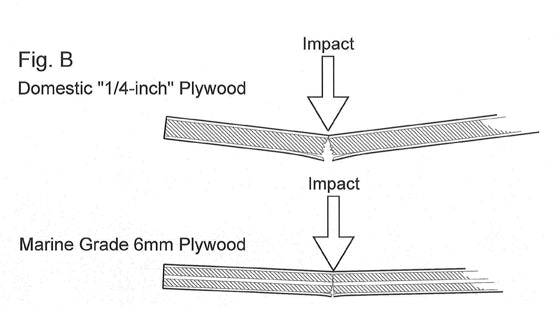
Figure B is pretty descriptive of the difference between so-called ¼” lauan and 6mm marine plywood: One has two thin face veneers and a thick, crumbly interior veneer. The other has five moderately thick veneers. Typical impact damage is shown: the lauan face veneers fail in tension and shear away from the core material. My own experience in building four boats out of lauan is that it doesn’t even take an impact to see core failures. The reason is that the core material is just a jumble of bits and pieces, not actual veneers, often with gaps and voids. Even worse, the machinery that sprays the glue between layers seems to hiccup often, leaving patches where the plywood layers aren’t glued together! Sometimes the cheap plywood just breaks when you bend it; sometimes you don’t discover the void in the glue until the boat is built and a blister appears out in the middle of the panel. That’s a major calamity when it happens.

Proper marine plywood has at least five veneers starting with 1/4-inch plywood; 3/4-inch plywood might have nine. The interior veneers are free of voids and always the same species as the face veneer. Thus, it’s okoume or sapele all of the way through. (Okoume plywood with a junky poplar core has been issued by various charlatans over the years.) Obviously such plywood is a great deal stronger and longer-lasting.
What If Okoume Marine Plywood is Just Unaffordable?
Can you just use extra fiberglass on the lauan and get away with it? I say: consider your priorities. The hull is about the last place I'd want to economize in a craft that will be taking me away from shore. Anyway, it’s a false economy: the extra epoxy and fiberglass you’ll need for sufficient strength will erase the $100 you saved in buying lauan.
And consider resale value. A wood-epoxy composite boat has a lifespan measured in decades. Building it with quality wood is not only more fun for the builder. It will enhance the value of the finished product a great deal when you stick it on CraigsList.
To save money, buy plywood in bulk with a group of amateur boatbuilders, or ask for slightly stained or damaged sheets of marine grade okoume. Consider building your own paddles or oars, scrounging for hardware, using less expensive paint or varnish, and holding off on that charting GPS before you cheapen the look, feel, longevity, and strength of your wooden boat.


