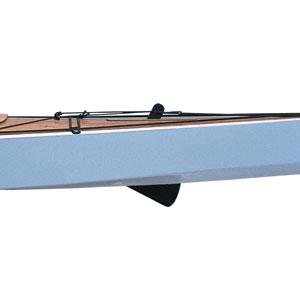
Installing a Retractable Skeg
Fitting Out Your BoatIf you paddle open water, you'll occasionally come upon conditions of wind and sea in which even the best-tracking kayak will broach or weathercock. A rudder is the common solution to these problems, but some paddlers don't like the complexity, looks, or cost of a rudder system. Like the feathers on an arrow, a skeg is just the thing for those conditions. Skegs are a marvelous improvement to a sea kayak except for one problem: you don't always need them. A fixed skeg can represent underwater drag, and sometimes it'll make you track too well. Thus, a retractable skeg is just the fix.
We've brewed up a skeg system that you can build into your wooden kayak or retrofit easily to an existing hull. The CLC Skeg is a variation of a proven system that boatbuilder Rob Bryan presented in WoodenBoat Magazine a few years back, and we think it's the easiest arrangement we've seen. Here's how to build one yourself.

1: 4mm marine plywood sides and 3/8" spacers create a hollow box for the 1/4" thick skeg, in the manner of a sailboat centerboard trunk. Build the box taller than the centerline height of the boat at the point where you plan to install the box. A 1/4" wooden dowel is the pivot for the skeg. Epoxy it in place so that it will never leak.
2: Locate the skeg box somewhere to the rear of the aft hatch. The skeg can be quite a ways forward of the stern and still perform well; as a practical matter, install it within reach of the aft hatch. Cut a rectangular hole in the deck and keel so that the skeg box slides into place. For now, a little of the box should extend above the deck and below the keel. When you have a good fit, secure the box in place with epoxy fillets to the underside of the deck and keel. When the epoxy has cured, trim the box flush with the deck and keel.

3: The skeg itself should be made out of marine plywood and coated with epoxy. So that it can be installed (and removed if necessary), cut a notch in the bottom of the skeg to fit over the pivot dowel.
4: Glue a 4mm plywood cap to the deck over the top of the box.
5: A 1/4" length of bungie led to the skeg from an eyestrap on the stern of the kayak deploys the skeg. 1/8" line run from the skeg to a cleat next to the cockpit allows you to deploy and retract the skeg remotely.
